

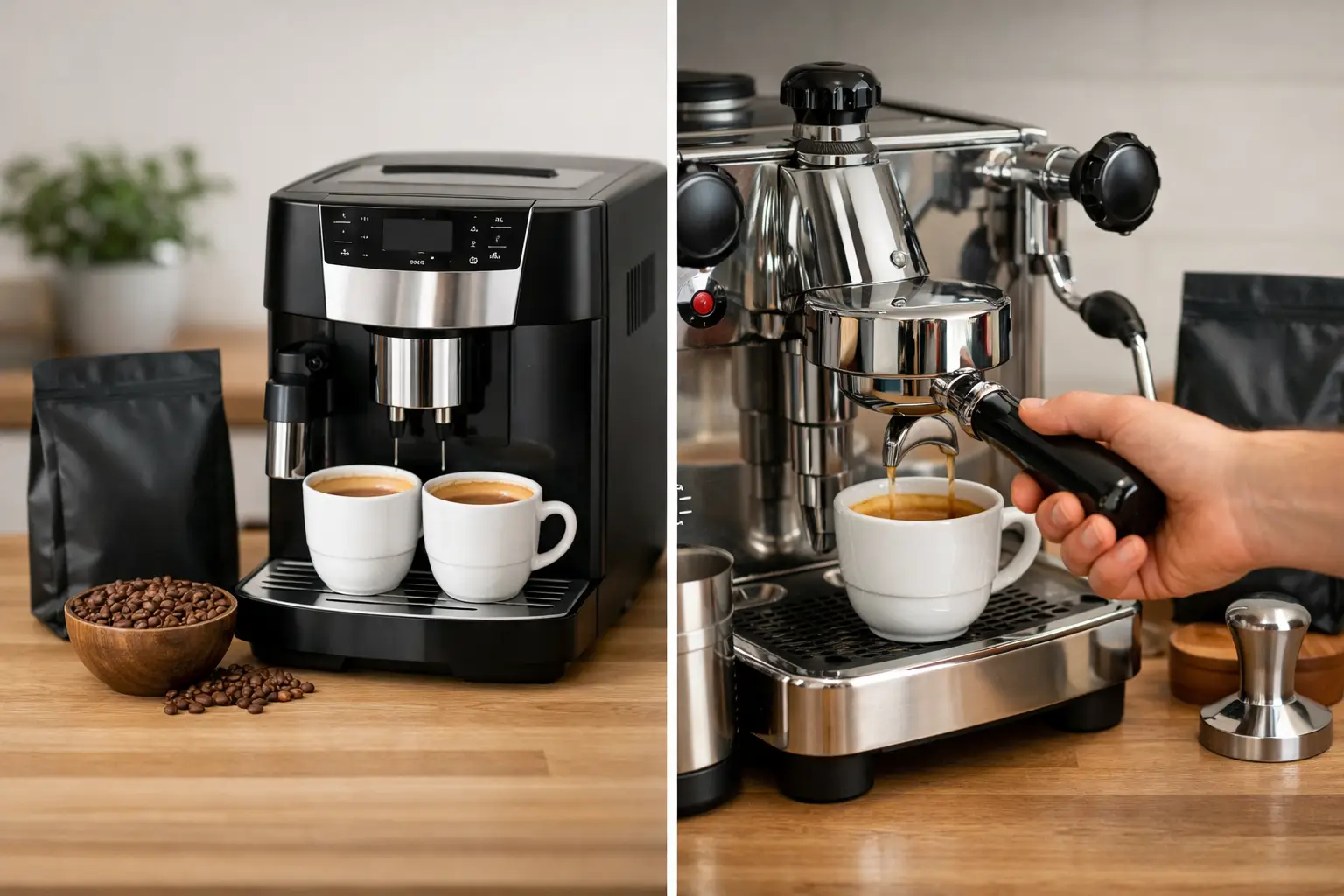
A busy morning tells you more about automatic vs manual coffee machines than any specification sheet. If the queue is building and every drink needs to taste the same, speed and repeatability become the priority. If the goal is a carefully dialed-in espresso that brings out the character of a fresh single-origin roast, hands-on control may matter more. The better machine is not the one with the longest feature list. It is the one that fits the people making coffee, the customers drinking it, and the volume you need to serve.
What separates automatic and manual coffee machines?
The terms can be confusing because coffee equipment is sold across a wide spectrum. In this comparison, an automatic coffee machine usually means a bean-to-cup or superautomatic system. It grinds the coffee, doses it, brews espresso, and, on many models, froths milk with preset drink options. The user selects a beverage and makes small adjustments through the menu.
A manual coffee machine usually refers to a traditional espresso machine operated with a portafilter. The barista grinds coffee separately, doses and distributes it, tamps the puck, starts the extraction, steams the milk, and combines the drink by hand. Many commercial machines are technically semi-automatic because they stop the shot automatically at a programmed volume. They are still considered manual in everyday café use because the barista controls the preparation.
There is also a middle ground. Automatic espresso machines with a separate grinder, volumetric group heads, or assisted tamping can reduce repetitive work while preserving much of the traditional barista workflow. That middle category is worth considering if you want better throughput without moving to a fully bean-to-cup setup.
Automatic vs manual coffee machines for daily service
Automatic machines prioritize consistency and speed
A quality automatic machine is designed to make familiar drinks with less training and fewer variables. Once the grinder setting, dose, beverage volume, and milk recipe are configured, staff can produce espresso, long black coffee, cappuccinos, and lattes with a repeatable result. This is especially useful in offices, hotels, convenience-led foodservice, and restaurants where coffee is important but not the center of the operation.
The strongest case for automatic equipment is operational. A new team member can prepare a drink after basic instruction instead of spending weeks learning shot timing, milk texture, and workflow. That can reduce pressure during peak periods and help businesses maintain a dependable standard across shifts or locations.
For home users, the appeal is equally practical. An automatic machine can turn whole beans into a coffee drink before work with very little preparation and minimal countertop clutter. It is a sensible choice for households that want café-style milk drinks but do not want to practice espresso techniques every morning.
That convenience comes with limits. Most superautomatic machines use a fixed brewing system and narrower adjustment range than a professional manual setup. You can often adjust strength, temperature, grinder level, and drink size, but you may not have the precision needed to get the best from every roast. Delicate light roasts and high-acidity coffees can be harder to fine-tune than they are on a manual machine.
Manual machines prioritize craft and flexibility
A traditional espresso machine gives the operator more control over the variables that shape the cup. Grind size, dose, yield, shot time, water temperature, pre-infusion, and milk texture can all be adjusted. With fresh beans and a capable grinder, that control can produce espresso with greater sweetness, clarity, and balance.
For a specialty café, this is more than a technical advantage. It gives the business room to feature seasonal coffees, change recipes as a roast develops, and build a beverage program around skilled baristas. A barista can pull a shorter, more syrupy shot for one coffee and a longer, brighter recipe for another. Milk can be textured differently for a flat white, latte, or cappuccino rather than dispensed to a single preset.
Manual equipment also creates a customer-facing coffee experience. The sound of grinding, the tamping routine, and latte art all communicate care. That matters when customers are choosing a café for its coffee, not simply adding caffeine to a meal.
The trade-off is that a manual machine does not create consistency by itself. Poor grinder calibration, uneven tamping, rushed steaming, or a lack of cleaning discipline can quickly affect drink quality. A good machine needs a good grinder, fresh coffee, water filtration, staff training, and a clear dial-in routine. Buying the machine is only one part of building reliable espresso service.
Think beyond the purchase price
The upfront price is visible. The ongoing cost of producing good coffee is where many buying decisions become clearer.
Automatic machines may reduce labor time, but they require regular cleaning cycles and, depending on the model, cleaning tablets, milk-system chemicals, filters, and periodic servicing. Milk lines need daily attention. Ignoring that routine affects hygiene, machine reliability, and flavor. Bean hoppers and internal grinders also need appropriate cleaning to prevent stale coffee buildup.
Manual machines can involve higher setup costs because they usually need a commercial grinder, water treatment, knock box, tampers, milk pitchers, and barista tools. They may also need more counter space and a stable plumbing or electrical setup. However, individual components can often be serviced or upgraded separately, and a well-maintained commercial espresso machine can support a high-volume operation for years.
Coffee waste should be part of the calculation too. A poorly trained team can waste beans and milk on a manual station while learning to dial in and steam consistently. An automatic machine may reduce those errors, although preset drinks can still waste product if recipes are not configured properly. The right choice depends on whether your bigger cost pressure is labor, training, ingredients, service downtime, or initial capital.
Match the machine to your menu and volume
A menu built around black coffee, espresso, and straightforward milk drinks can work well with either format. The decision becomes more specific when you consider volume and customization.
For a small restaurant, office pantry, bakery, or self-service setting, automatic equipment is often the practical answer. It keeps service moving, supports staff with varying experience levels, and delivers a recognizable drink without a dedicated barista on every shift. Select a model with enough daily capacity for your busiest hour, not just your average day.
For a specialty café, brunch venue, or business where espresso is a signature product, manual equipment usually offers more value. It supports high-output workflows when paired with the right grinder and gives the team the ability to make each coffee taste intentional. A two-group or three-group machine can handle several drinks at once, while multiple grinders make it easier to offer separate espresso and decaf recipes.
Home buyers should be honest about their routine. Choose automatic if convenience will make you use the machine more often. Choose manual if making coffee is part of the enjoyment and you are willing to learn grinder adjustment, puck preparation, and milk steaming. There is no prize for owning a machine that is more complicated than your schedule allows.
The grinder matters as much as the machine
A coffee machine cannot compensate for stale beans or an inconsistent grind. This is particularly true with manual espresso, where the grinder has a direct effect on extraction time and flavor. A precise espresso grinder makes it easier to repeat recipes, reduce clumping, and adjust for changes in humidity or bean freshness.
Automatic machines include a built-in grinder, which is convenient and space-efficient. Before buying, check whether it offers enough adjustment steps for the coffees you plan to use. Medium to medium-dark espresso blends are generally the easiest fit for bean-to-cup systems because they produce body and sweetness at common settings. If you regularly buy lighter specialty roasts, ask whether the machine can achieve the recipe range those coffees need.
Freshness matters in both cases. Buy coffee in quantities that suit your weekly usage, store it away from heat and light, and adjust the recipe when you change to a different roast. A dependable machine performs best when the coffee going into it is treated with the same care.
Questions worth asking before you buy
Before choosing, consider who will operate the machine, how many drinks you need to serve during peak periods, and whether milk drinks are central to the menu. Ask how much counter space, water access, and electrical capacity you have. Confirm the cleaning routine and whether your team can complete it every day.
For business buyers, service support and parts availability deserve the same attention as drink quality. Equipment downtime can interrupt sales and frustrate customers, so a machine should be selected with realistic maintenance access in mind. It is also wise to test your preferred beans and recipes before committing, especially if espresso is a key part of your offering.
Auresso can help simplify that decision by matching coffee equipment, grinders, and beans to the way you actually serve drinks, whether that means a fast office setup or a café bar built around specialty espresso.
The best coffee setup is one your team can maintain, your budget can support, and your customers will enjoy returning to. Start with the cup you want to serve at your busiest moment, then choose the machine that makes that cup achievable every day.