

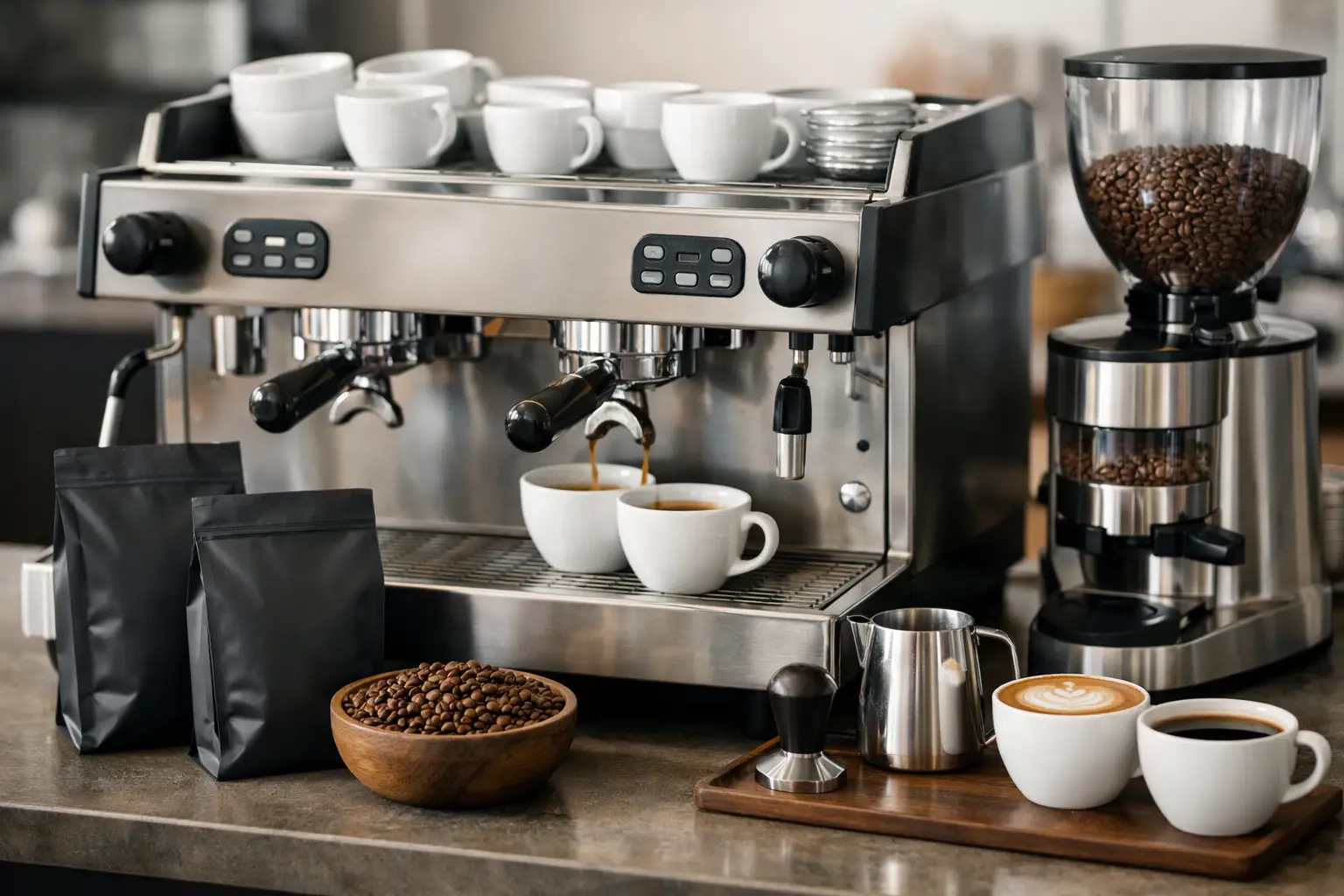
A busy morning rush will expose every weak point in your bar setup. If your grinder drifts, your machine struggles to recover, or your workflow forces staff to take extra steps, drink quality drops fast. A good commercial espresso equipment guide should help you avoid that kind of expensive trial and error and choose a setup that keeps up with service.
For most cafés and foodservice operators, the right equipment is not the most advanced machine on the market. It is the system that fits your menu, staff skill level, daily volume, counter space, and service style. That distinction matters because espresso equipment is a capital purchase, but it is also an operational decision. The wrong setup costs you in speed, consistency, labor, and maintenance long after the invoice is paid.
What a commercial espresso equipment guide should actually help you decide
A lot of buying advice starts with brand names and feature lists. That is useful later, but first you need clarity on how the equipment will be used. A café pulling 250 milk-based drinks a day has very different needs than a brunch restaurant adding espresso to an existing beverage menu. Both need reliability, but not necessarily the same boiler capacity, workflow layout, or grinder configuration.
Start with three realities. First, how many drinks will you serve during your busiest hour, not just in a full day. Second, what mix of drinks will dominate the menu. Third, who will operate the station. A highly trained specialty bar team can get excellent results from a setup that rewards precision. A mixed-skill team in a high-turnover environment usually benefits from more forgiving equipment with programmable controls and simpler routines.
Choosing the espresso machine
The machine gets the most attention, but the smartest choice usually comes down to output stability and usability. If your business is heavily milk-based, recovery speed and steam power matter as much as shot performance. If you are focused on straight espresso and Americanos, temperature control and shot consistency may carry more weight.
One-group, two-group, or three-group
For most commercial accounts, a one-group machine is only suitable for very low-volume service, kiosk concepts with a limited menu, or businesses where espresso is secondary. It can work, but it leaves very little room for peak-hour pressure.
A two-group machine is the practical standard for many cafés. It gives enough capacity for steady service, supports multiple baristas when needed, and usually makes the best use of counter space versus output. For many operators, this is the sweet spot.
A three-group machine makes sense when volume is high and workflow is already strong enough to justify it. Bigger is not automatically better. If your demand does not require it, a larger machine adds cost, uses more power, and may take longer to justify financially.
Semi-automatic vs volumetric
This choice depends on your team. Semi-automatic machines give baristas more manual control over shot timing, which can appeal to specialty programs. Volumetric machines use programmed shot volumes, helping create faster, more repeatable output across shifts.
If you are training new staff regularly or running multiple locations, volumetric control can be a practical advantage. If your concept is built around barista craft and you have the staffing to support that, manual control may be worth the trade-off.
Boiler design and temperature stability
Single boiler heat exchanger machines can still perform well in many settings, but dual boiler systems often offer better temperature management, especially when the menu includes a lot of milk drinks. Stable temperature means more predictable extraction, and in a commercial environment, predictability is money.
That said, advanced temperature control only pays off if your grinder, coffee, and staff routines are equally disciplined. There is no point buying a machine with high-end thermal performance if calibration on the bar is inconsistent all week.
The grinder is not the side purchase
If there is one mistake buyers make repeatedly, it is overspending on the machine and underspending on the grinder. Espresso quality lives and dies at the grinder. Poor particle consistency, retention issues, or slow grinding speed will create problems your espresso machine cannot fix.
A dedicated espresso grinder should match your expected volume and service pace. In a busy café, grind speed matters because every second compounds during rush periods. Dose consistency matters because inconsistent shots create waste and force staff to chase the recipe all day.
On-demand vs single-dose in commercial settings
For most cafés, on-demand grinders remain the practical choice. They are faster, simpler during service, and easier to integrate into a repeatable workflow. Single-dose grinding has a place in highly specialized bars, but for general commercial use, it often adds friction unless the concept is built around low-volume precision service.
One grinder or two
A single grinder can be enough for a focused menu. But if you offer regular espresso and decaf, or if you want a second espresso option, a two-grinder setup is often worth the space. It improves service flexibility and avoids awkward workarounds during busy periods.
Water filtration is part of the equipment plan
Any serious commercial espresso equipment guide should treat water as essential, not optional. Water quality affects flavor, machine longevity, scale buildup, and maintenance frequency. Good coffee can taste flat or harsh with poor water, and a machine exposed to untreated water will usually cost more to maintain over time.
Your filtration setup should be matched to local water conditions and your equipment requirements. This is one of those areas where saving money upfront can become expensive later. A reliable filtration plan protects both cup quality and the equipment investment behind it.
Build the station, not just the machine package
Espresso service depends on the full station working together. The machine and grinder are central, but they are not the whole system. Your layout should support speed, cleanliness, and repeatability.
Think about refrigeration for milk, cup placement, tamping position, knock box location, pitcher rinse access, and barista movement between tasks. If the station forces twisting, reaching, or unnecessary steps, service slows and fatigue builds across the shift. That may sound minor on paper, but over hundreds of drinks it becomes very real.
A compact station can still perform well if it is organized correctly. A large station can still be inefficient if it is planned poorly. Workflow is where good equipment either proves its value or gets undermined.
Match equipment to your menu
An espresso-forward specialty café usually needs a different setup than a broader beverage business. If milk beverages drive the majority of sales, prioritize steam recovery, bar layout, and pitcher workflow. If you also serve matcha, chai, chocolate, or tea-based drinks, your counter and staff process need to support that mix without crowding the espresso station.
This is especially relevant for operators expanding beyond coffee into a full beverage program. The best setup is not always the most coffee-specialized one. It is the one that keeps your most profitable drinks moving consistently.
Consider serviceability before you buy
Downtime is expensive. That is why service support, parts access, and routine maintenance requirements should carry real weight in your decision. A machine with impressive specs is less attractive if support is slow or replacement parts are hard to source.
Ask practical questions. How often does the machine need preventive maintenance? Are wear parts readily available? How easy is it to clean at the end of a shift? Does the interface make daily use easier or more confusing for staff?
The best commercial equipment is not just good on installation day. It remains manageable six months later when the team is busy and the machine is part of the daily grind.
Budget with the full cost in mind
Equipment budgets often focus too narrowly on the espresso machine price. In reality, your total setup may include grinders, filtration, refrigeration, bar tools, electrical work, plumbing, and preventative service. If you are planning a new store or a beverage program upgrade, these costs should be viewed as one operating system.
There is also a difference between cheap and cost-effective. A lower entry price can be sensible if the volume is modest and the concept is simple. But if your sales target depends on speed and consistency, underbuying usually shows up as labor inefficiency, waste, and customer complaints.
For many operators, the smarter move is to buy the level of equipment that matches the business you expect to run in the next two to three years, not just the one you have today.
A practical commercial espresso equipment guide for final decision-making
Before you commit, pressure-test the setup against your actual service. Picture your busiest hour. Count the number of milk drinks. Think about who is dialing in the grinder at open, who is cleaning at close, and how much margin for error your team realistically has.
If a machine is highly capable but difficult for your staff to use consistently, it is probably the wrong machine. If a grinder saves money upfront but slows down service, it is not really saving money. And if your water, layout, or maintenance plan is an afterthought, the rest of the investment will not perform the way it should.
For cafés, restaurants, and beverage businesses, the best equipment decision is usually the one that balances cup quality with dependable service. That balance is what turns equipment from a purchase into an asset. Choose the setup that lets your team work confidently, your drinks stay consistent, and your customers come back for the next round.