

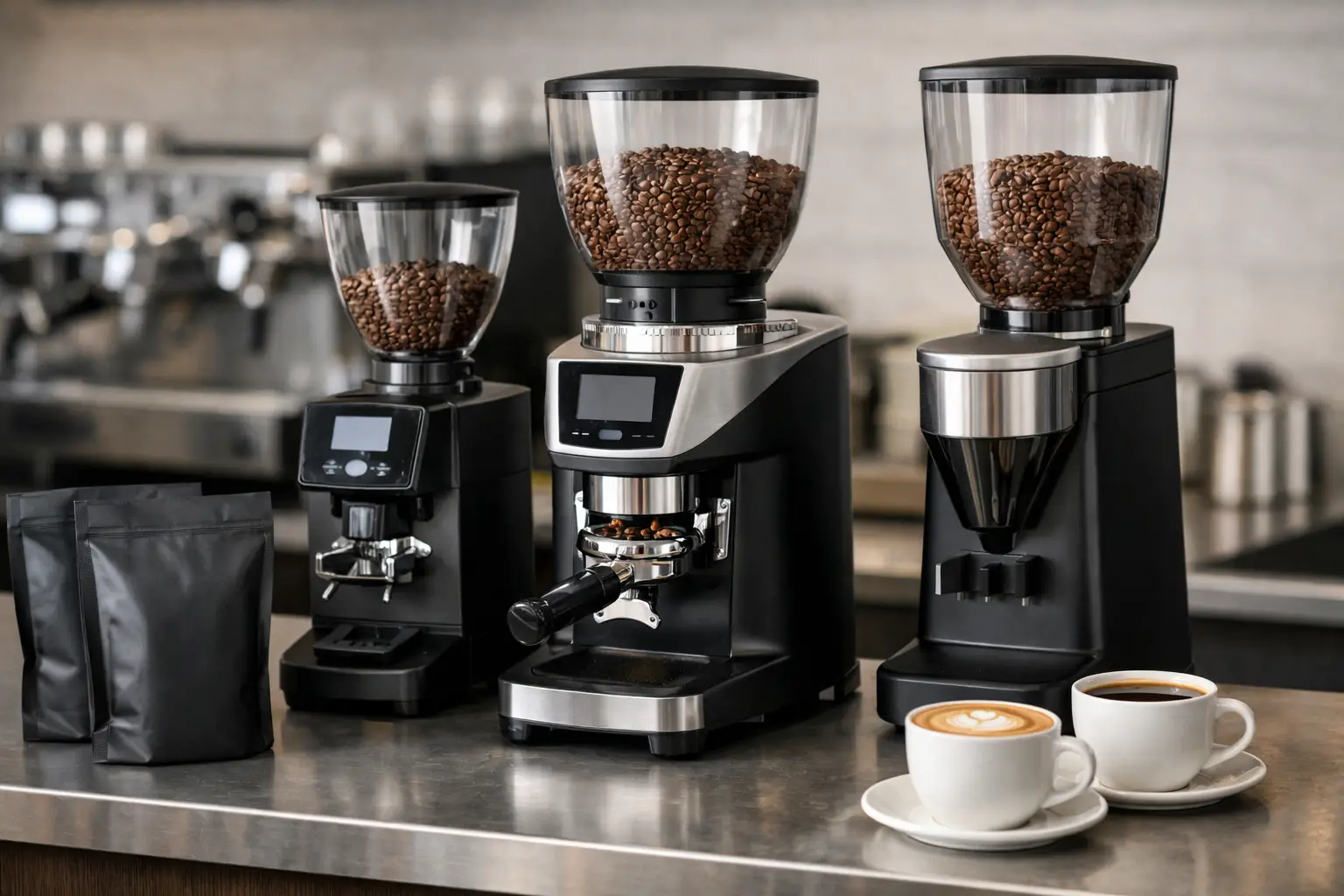
The morning rush exposes a grinder faster than any specification sheet. When orders are stacked, baristas are switching between regular and decaf, and every espresso needs to land on recipe, the question is not simply which grinder fits busy cafes. It is which grinder keeps service moving without sacrificing cup quality, staff confidence, or maintenance sanity.
For a busy café, the grinder is a production tool as much as an espresso tool. The right choice depends on peak-hour drink volume, menu complexity, coffee style, counter space, and the support available when wear parts eventually need attention. A large burr set may be the right answer for one shop, while a pair of well-matched grinders makes more commercial sense for another.
Start With Your Real Peak-Hour Volume
Do not choose based only on average daily cups. A café that serves 180 espresso drinks per day can have very different needs from another café serving the same total across a longer, quieter service. What matters is the busiest 30 to 60 minutes.
If your bar regularly receives a new ticket every 20 to 30 seconds during peak periods, prioritize fast grinding, low heat buildup, and a hopper capacity that does not require constant refilling. A commercial espresso grinder with larger burrs usually grinds faster and handles repeated doses with less strain. That helps maintain a more consistent particle profile and reduces the wait between drinks.
For moderate-volume cafés, a capable on-demand grinder may be enough if the bar menu is focused and baristas can work efficiently. But if the grinder is already the bottleneck, buying a slightly faster model is not a luxury. It can improve ticket times, reduce rushed dosing, and give baristas more room to focus on extraction and milk texture.
Think in Rushes, Not Daily Totals
A useful planning exercise is to count drinks during your busiest half hour, then estimate how many are espresso-based. If 35 of 45 drinks need espresso, a slow grinder will be felt immediately. Add a second grinder for decaf or another espresso option, and the main grinder no longer has to carry every order alone.
Burr Size and Burr Type Affect More Than Speed
Burrs determine how coffee is cut, how quickly doses are delivered, and how the espresso presents in the cup. Larger burrs are generally faster, but their value is not limited to seconds saved. Faster grinding can mean less heat transfer during heavy use, which supports more stable flavor as the rush continues.
Flat burr grinders are often chosen for clarity, separation, and a more structured flavor profile. They can suit cafés serving carefully developed espresso recipes or coffees where sweetness and distinct flavor notes matter. Conical burr grinders are often appreciated for their fuller body and forgiving workflow, particularly when recipes need to perform across changing staff shifts and customer traffic.
Neither burr type wins in every setting. The coffee you serve, your water, your espresso machine, and your preferred cup profile all matter. A café built around traditional, chocolate-forward milk drinks may prioritize a different grinder character than a bar serving lighter roasted single origins as espresso.
The practical rule is simple: taste the coffee on the grinder under consideration, using a comparable recipe and machine setup. Speed matters, but a grinder that does not support the flavor standard of your menu is not a good operational investment.
Which Grinder Fits Busy Cafes With Complex Menus?
For cafés offering regular espresso, decaf, and rotating guest coffees, the best answer is often not one bigger grinder. It is a sensible grinder station.
A high-capacity primary grinder should handle your house espresso, the coffee that carries most cappuccinos, lattes, Americanos, and straight shots. A dedicated second grinder for decaf prevents delays and avoids the compromise of emptying hoppers or purging heavily between coffees. If single-origin espresso is part of your program, a third grinder may earn its counter space by protecting the house blend workflow.
This arrangement also gives the bar a measure of resilience. If one grinder needs cleaning, calibration, or service, the café is not completely unable to serve espresso. For operators, that backup capacity can be worth more than the small savings of relying on one machine for every bean.
Where space and budget are tight, prioritize a strong primary grinder and a reliable compact decaf grinder. A decaf option should still be capable of repeatable espresso. Treating it as an afterthought can produce slow drinks and inconsistent shots at precisely the moment customers expect the same care as they receive with regular coffee.
Look for Workflow Features Baristas Will Actually Use
A good café grinder should make the correct action the easy action. Programmable dosing is valuable because it gives staff a repeatable starting point for single, double, or custom doses. It does not replace dial-in, but it helps reduce variation between baristas and shifts.
Low-retention design is another practical consideration. Coffee left in the chute can make the first shot after an adjustment less predictable, and it can be especially frustrating when switching between coffees. Some retention is normal in commercial equipment, but a grinder that is easy to purge and clean supports faster, more reliable adjustments.
Also consider the display, dosing controls, portafilter support, and access to the adjustment collar. During a rush, staff should not need two hands to hold a portafilter in place while searching through complicated menus. Simple controls, a stable hands-free fork, and an adjustment system that is precise without being awkward all make a real difference.
Noise is worth considering as well. Grinding will never be silent, but an extremely loud grinder can make customer conversations and barista communication harder in a small café. This is usually a secondary factor behind speed and consistency, yet it matters for compact counters and open-bar concepts.
Plan for Heat, Retention, and Dialing In
Busy service creates heat. Frequent grinding can warm burrs and the coffee path, changing grind behavior over the course of the day. This is one reason a grinder that performs well during a quick showroom test may behave differently after 100 doses.
Choose a grinder designed for your expected workload, then build dialing-in checks into the opening routine and key service transitions. A barista should know the target dose, yield, shot time, and taste profile for the house espresso. When a shot drifts, small grind adjustments should be made deliberately rather than repeatedly changing dose, time, and temperature all at once.
A larger burr grinder can provide greater stability under sustained demand, but it still needs routine attention. Humidity, roast age, coffee density, and ambient temperature can all affect extraction. Equipment capacity reduces stress in the system; it does not remove the need for barista judgment.
Serviceability Is Part of the Purchase Price
The least expensive grinder is not always the best value for a working café. Consider burr life, cleaning access, availability of replacement parts, local technical support, and expected downtime if a repair is needed. A grinder that is difficult to service can cost far more in lost sales and staff frustration than the initial price difference suggests.
Ask how often the burrs should be inspected or replaced based on your projected volume. Ask whether regular cleaning can be completed by the team without complicated disassembly. And ask what happens when you need a switch, display, motor component, or burr carrier replaced.
For cafés in Malaysia and Singapore, sourcing equipment and consumables through a supplier that understands commercial beverage operations can simplify this decision. Auresso can help operators consider grinders alongside espresso beans, drink ingredients, and the practical requirements of their menu, rather than treating the purchase as an isolated equipment decision.
A Smart Buying Framework
Before committing, evaluate each grinder against the same operating questions:
- Can it produce your peak-hour espresso volume without creating a line at the grinder?
- Does its burr set deliver the flavor profile your menu promises?
- Can baristas dose, adjust, and clean it quickly and consistently?
- Will your counter layout support a second grinder for decaf or guest espresso?
- Are service, burrs, and replacement parts realistically available for your business?
If a grinder performs strongly in only one category, such as speed or price, keep looking. The best café grinder balances output, cup quality, usability, and ownership costs.
A busy café does not need the most expensive grinder on the market. It needs the grinder that fits its rush, its coffee, and its team well enough that every barista can make the next good drink without holding up the line.