

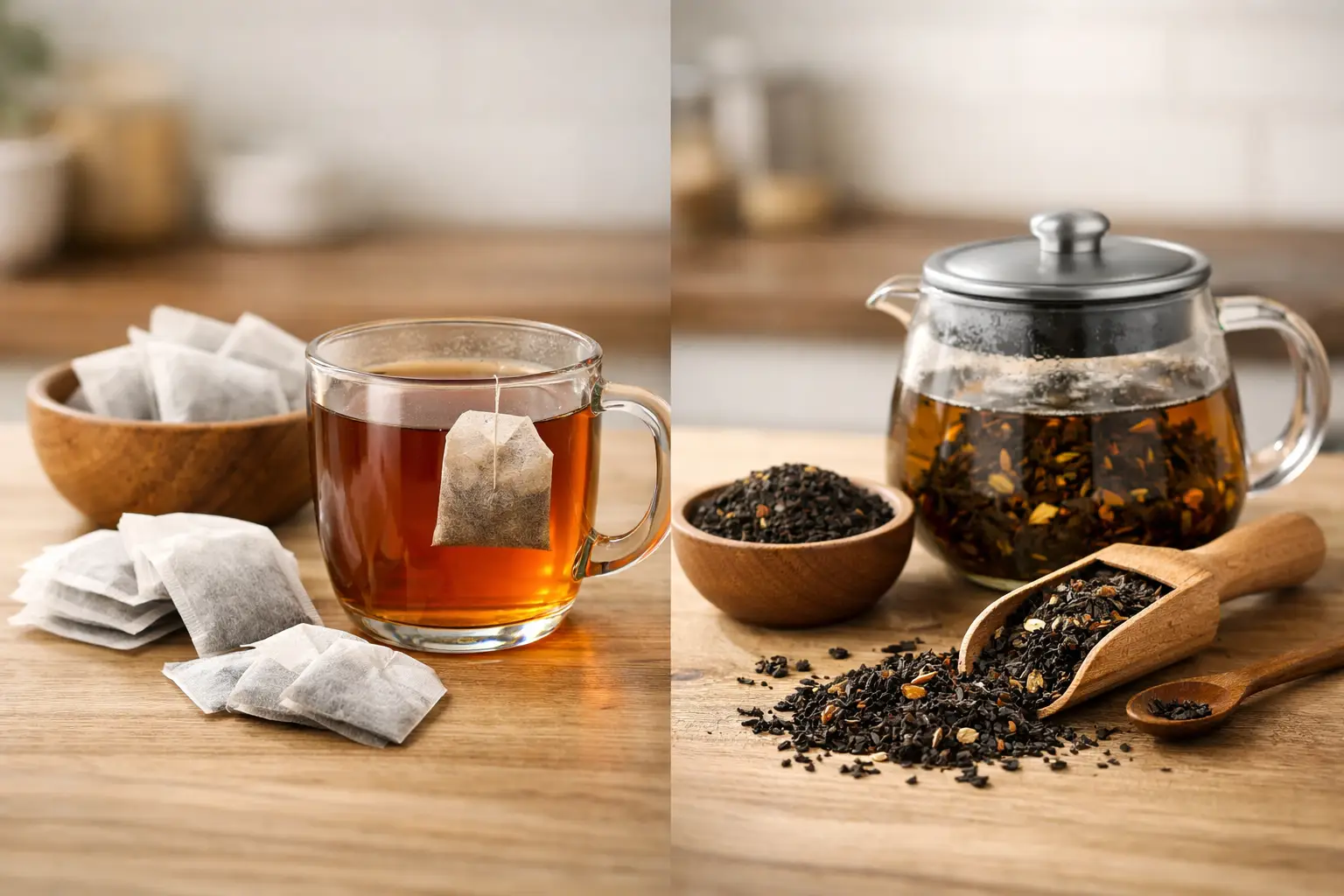
The difference between teabags vs loose leaf tea usually shows up in the cup before it shows up on the price tag. One gives you speed and consistency with almost no prep. The other gives you more control over flavor, aroma, and leaf quality. If you are buying for home, that decision affects your daily ritual. If you are buying for a café or foodservice setup, it affects labor, storage, waste, and how reliably each cup tastes during a busy shift.
This is why the better question is not which format is universally better. It is which one fits your use case better.
Teabags vs loose leaf tea: what actually changes?
At a basic level, both can make a good cup. The real difference is the leaf inside, how much space it has to expand, and how much control you have over brewing.
Loose leaf tea usually contains larger, more intact leaves. That matters because whole or larger leaf pieces tend to hold onto more of their natural oils and aromatic compounds. When they steep with enough room, they release flavor gradually and with more definition. You are more likely to notice clearer floral notes, cleaner tannins, brighter citrus, or deeper malt depending on the tea.
Teabags are built for convenience first. Many contain smaller leaf grades, fannings, or dust because those particles infuse quickly. That can be useful when speed matters, but it can also create a flatter or more one-dimensional cup, especially if the tea is over-steeped. Not every teabag is low quality, though. Pyramid bags and better specialty bagged teas can perform very well because they use better leaf and allow more expansion.
So the short answer is simple. Loose leaf tends to offer more quality potential. Teabags tend to offer more operational ease.
Flavor, aroma, and cup quality
If your priority is taste, loose leaf usually has the edge.
The larger leaves often produce a fuller aroma and a more layered cup. Green teas can taste fresher and less harsh. Black teas can show more body without becoming aggressively bitter. Herbal infusions often come across as more vivid because you can see and assess the cut of the ingredients instead of relying on what is hidden inside a sachet.
That said, flavor is not just about format. Water temperature, steep time, and storage matter just as much. A poorly stored loose leaf tea can taste tired fast. A well-packed premium teabag can outperform cheap loose tea with no character. Buyers sometimes assume loose leaf automatically means premium, but the source and handling still decide most of the result.
For cafés, this is where the menu matters. If tea is a featured category, loose leaf gives you more room to differentiate. Customers notice when a jasmine green actually smells fragrant or when an English breakfast has structure instead of just strength. If tea is a small supporting item on a coffee-led menu, a reliable high-quality teabag may make more business sense.
Convenience and speed during real use
This is where teabags earn their place.
They are fast to portion, simple to train staff on, and easy for customers to understand. In self-serve stations, hotel breakfast setups, meeting rooms, and high-volume operations, teabags reduce guesswork. There is no scooping, no straining, and less cleanup. For home drinkers, they also remove friction. If someone wants a cup before work or late at night, convenience matters.
Loose leaf asks more from the user. You need an infuser, pot, filter, or brewing basket. You need to measure the tea. You need to manage spent leaves afterward. None of that is difficult, but it is one more step every time. In a busy café, those extra steps can slow service if tea is not a core focus and staff are already stretched on espresso, blended drinks, and food orders.
This is one of those cases where better quality does not always mean better fit. A product can be excellent and still be the wrong operational choice.
Cost is not as simple as it looks
Many people compare teabags and loose leaf by shelf price alone, and that usually misses the point.
Teabags often look more affordable because the format is familiar and portions are pre-packed. Loose leaf can seem more expensive upfront, especially when sold in larger packs or premium single-origin styles. But cost per cup can shift depending on the tea grade, serving size, and how carefully it is brewed.
Loose leaf can be cost-efficient when the quality is high enough that you need less tea for a satisfying cup, or when certain teas can handle multiple infusions. On the trade side, though, labor cost has to be counted too. If making loose leaf tea slows service or creates inconsistency across staff, the cheaper ingredient cost may not translate into a better overall margin.
Teabags also reduce portioning mistakes. For operations that need predictable food cost and straightforward inventory control, that consistency has value. There is less chance of one staff member making a weak tea and another over-dosing the next cup.
Teabags vs loose leaf tea for cafés and foodservice
For business buyers, the best format usually comes down to menu positioning and workflow.
If tea is a premium offering, loose leaf helps support that story. It looks more artisanal, gives staff more to talk about, and can justify a higher selling price when presented well. It works especially well in cafés with slower service models, table service, or customers who are already interested in specialty beverages.
If tea is a secondary category, teabags are often the smarter choice. They help maintain speed, keep training simple, and make stock planning easier. This matters in compact kitchens, takeaway-heavy stores, kiosks, and multi-drink menus where tea must fit into a broader beverage system without creating friction.
Some businesses do best with a mixed approach. Keep premium loose leaf options for signature teas, dine-in service, or upsell moments, and use quality teabags for standard black tea, chamomile, or peppermint. That model gives you range without overcomplicating operations.
For buyers in Malaysia and Singapore, where cafés often balance quality expectations with fast-moving service, that hybrid setup can be especially practical.
Storage, shelf life, and consistency
Tea is sensitive to air, heat, moisture, and strong odors. That applies to both formats, but the storage experience is different.
Teabags are easier to organize and portion. For many businesses, that translates into cleaner stations and less handling. Individually wrapped bags also offer protection and help preserve freshness, though they add packaging.
Loose leaf requires more disciplined storage in airtight containers and a bit more attention to rotation. The payoff is better visibility. You can inspect the leaf, monitor aroma, and judge quality directly. For enthusiasts, that transparency is part of the appeal. For busy staff, it can be one more thing to manage.
Consistency also tends to be easier with teabags, especially across multiple team members. Loose leaf can be highly consistent too, but only when SOPs are clear and the brewing tools are standardized.
Sustainability and packaging
This category depends heavily on the product itself.
Loose leaf often uses less individual packaging, which can be a plus. But it may still come in layered retail packaging depending on the brand. Teabags can create more waste, especially if each bag is wrapped, tagged, and boxed. On the other hand, some modern teabags use plant-based sachets and more thoughtful materials.
It is worth checking what the bag is made from. Some tea bags are paper-based, while others may include plastic components or sealing materials. If sustainability is part of your buying criteria, the format alone will not tell you enough.
So which one should you buy?
For home drinkers who care most about flavor and enjoy the process, loose leaf is usually the stronger choice. It gives you more control, often better aroma, and a more premium experience cup to cup.
For people who want dependable tea with minimal effort, teabags are hard to beat. They are efficient, tidy, and easy to keep on hand.
For cafés and beverage programs, the answer should come from service design, not preference alone. Choose loose leaf when tea is part of your quality story and staff can support the preparation. Choose teabags when speed, training simplicity, and cup-to-cup consistency matter more. And if your menu needs both convenience and a premium tier, use both formats deliberately.
Good tea buying is not about following a rule. It is about matching the product to the cup you want to serve and the operation behind it. If you start there, the right format becomes much easier to spot.