

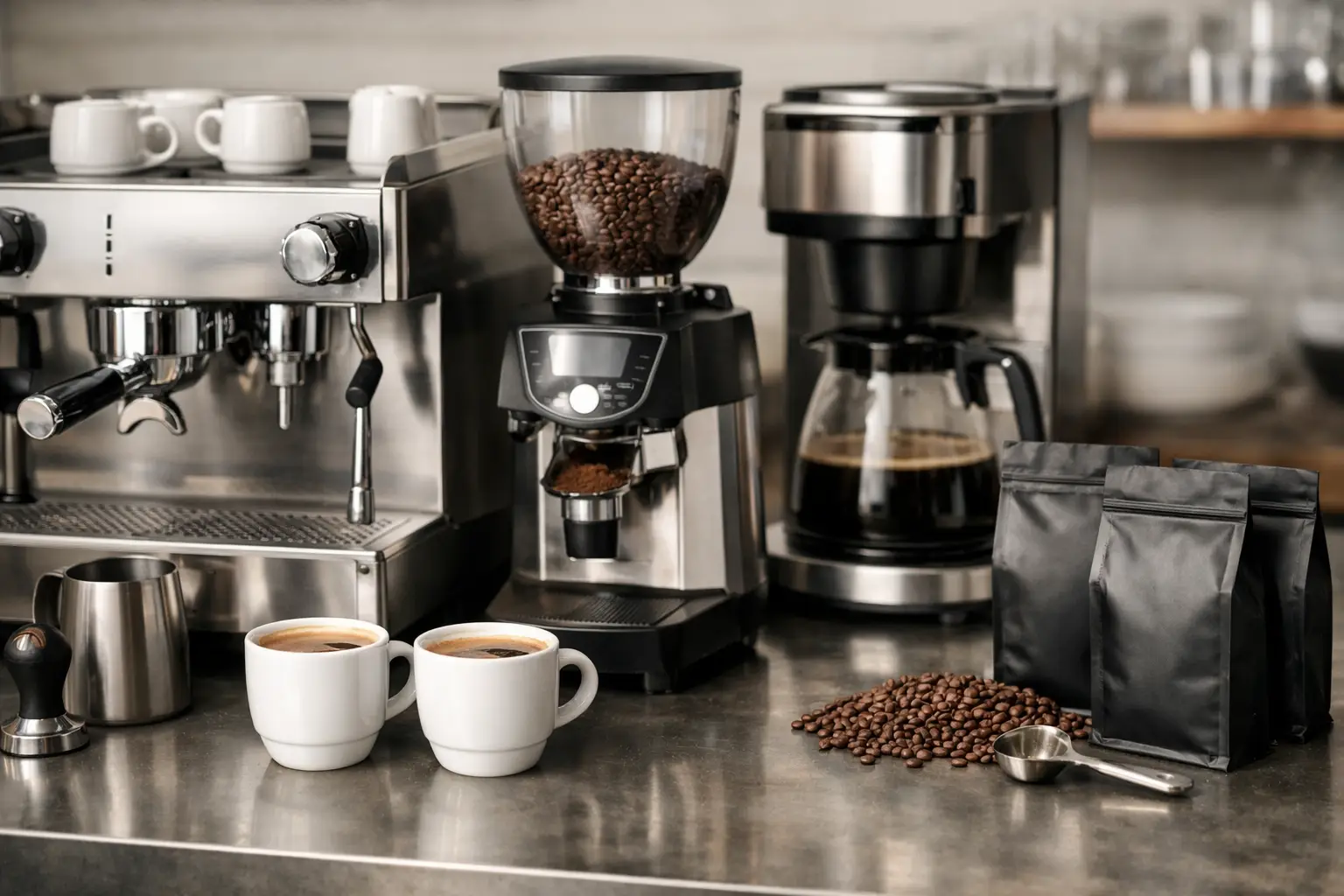
A rush that starts at 8:00 a.m. can expose every weak point in your bar setup by 8:07. Drinks stack up, milk texture turns inconsistent, grinders drift, and staff start working around the equipment instead of with it. That is why choosing commercial coffee equipment is not just a purchasing task. It is an operations decision that affects speed, drink quality, training, maintenance, and margin every single day.
For a café, restaurant, hotel, or office beverage program, the right setup should make service more consistent and less stressful. It should also fit the kind of menu you actually sell, not the one you imagine selling six months from now. That sounds obvious, but many buyers still overinvest in features they rarely use or underinvest in capacity they need from day one.
What commercial coffee equipment really needs to do
The best equipment earns its place by supporting repeatable service. In practice, that means stable brewing temperature, reliable output, manageable cleaning routines, and controls that your team can learn quickly. A machine may look impressive on paper, but if it slows down your workflow or demands constant intervention, it becomes expensive in ways that do not show up on the invoice.
Capacity is usually the first decision point. A compact setup may work beautifully for a low-volume kiosk or boutique office pantry. A busy café with a full espresso menu, however, needs enough boiler power, group capacity, and grinder throughput to keep up during peak periods. If your team regularly queues milk drinks, a machine that struggles with simultaneous brewing and steaming will create delays fast.
There is also the question of drink mix. If most of your orders are espresso-based milk drinks, your priorities will be different from a breakfast concept serving large batches of brewed coffee. If you offer matcha, chai, chocolate, and tea alongside coffee, your counter space and equipment layout matter even more. The right choice is rarely about one machine in isolation. It is about how the whole beverage station works together.
Start with your menu, not the machine
A lot of equipment mistakes begin with shopping by brand or appearance before defining the menu. A cleaner approach is to map your expected sales into drink categories. Espresso drinks, batch brew, manual brew, specialty powders, and iced beverages all place different demands on your setup.
If espresso is your core revenue driver, your machine and grinder deserve the biggest share of attention. If brewed coffee drives morning volume, a reliable bulk brewer or thermal brewing system may give you a better return than putting every dollar into espresso. Some businesses need both, especially if they serve office workers in the morning and café traffic throughout the day.
Menu complexity also affects labor. A broad beverage offering can increase ticket size, but it can also slow service if your station is not designed well. That is why commercial coffee equipment should be selected as a system. Espresso machine, grinder, water filtration, blender if needed, batch brewer, and smallwares all need to support the pace and style of service you want.
Espresso machines: where speed and consistency meet
For most specialty-focused operators, the espresso machine is the centerpiece. The key question is not just whether it makes good coffee. It is whether it can make good coffee consistently under pressure. Temperature stability, recovery time, steam strength, and ease of programming all matter.
A two-group machine is a common starting point for many cafés, but it is not automatically the right answer for every business. A smaller operator with modest traffic may do very well with a compact commercial unit, while a high-volume site may need more headroom for peak periods, back-to-back milk drinks, and multiple baristas working at once.
Automation is another trade-off. Traditional machines offer greater hands-on control and can appeal to experienced baristas. Super-automatic or highly programmable systems can reduce training time and improve consistency, especially in environments where coffee is one part of a larger foodservice operation. Neither approach is universally better. It depends on your staff skill level, labor model, and customer expectations.
Grinders matter more than many buyers expect
It is common to focus on the espresso machine and treat the grinder as secondary. That usually leads to disappointment. Poor grind consistency can waste great beans and make dialing in harder than it should be. For espresso service, the grinder has a direct effect on shot quality, speed, and waste.
If your volume is high, single-dosing may sound appealing from a craft perspective but can become impractical in service. On-demand commercial grinders often make more sense for busy counters because they support faster workflow and more stable output. For lower-volume programs with rotating coffees, a different approach may be justified. Again, it depends.
Retention, adjustment precision, burr quality, and serviceability all deserve a close look. So does noise. In an open café or quieter hospitality space, grinder noise can shape the customer experience more than expected.
The overlooked parts of commercial coffee equipment
Machines and grinders get the attention, but support equipment often determines how well the whole setup performs. Water filtration is a good example. Poor water quality can affect flavor, scale buildup, and equipment lifespan. Skipping filtration to save money upfront usually costs more later in maintenance and inconsistent cup quality.
Refrigeration and milk management are also part of the equation. If your bar team has to reach awkwardly for milk, syrups, or powders during every order, your service times will suffer. Countertop layout, pitcher rinse stations, tamping setup, knock boxes, and cup organization may seem small, but together they shape daily efficiency.
For batch coffee programs, thermal servers, holding solutions, and brewer programming can be just as important as brew capacity. A mediocre holding setup can make fresh coffee taste tired long before the rush ends.
Budgeting without buying twice
Price matters, especially for newer operators managing startup costs. But the cheapest option is not always the best value, and the most expensive option is not automatically future-proof. Good budgeting means looking beyond sticker price to total cost of ownership.
That includes maintenance, parts availability, energy use, water filtration requirements, training time, and expected lifespan. It also includes downtime. If one equipment failure can stop your beverage sales for hours, reliability becomes a revenue issue, not just a technical one.
A useful way to think about budget is to divide equipment into must-perform and nice-to-have categories. Espresso machine, grinder, and filtration usually belong in the first group. Certain advanced features may be worth delaying if they do not improve speed, quality, or consistency for your current operation.
For buyers in Malaysia and Singapore, local availability and support can add real value. Imported equipment with long lead times for parts may look attractive initially, but service delays can become costly in a live commercial setting.
How to judge fit before you buy
Specification sheets tell only part of the story. The better question is how the equipment behaves in your kind of service environment. If possible, think through your busiest hour in detail. How many milk drinks are queued? How often will you change grind settings? Who will clean and maintain the machine? How experienced is the average staff member using it?
It helps to assess equipment with three filters: output, usability, and support. Output is straightforward – can it handle your real demand. Usability covers programming, cleaning, workflow, and training. Support includes spare parts, service response, and supplier guidance.
This is where a dependable supplier can make a major difference. Businesses such as Auresso are valuable not just because they carry coffee machines, grinders, beans, and café ingredients in one place, but because that product range makes it easier to build a setup that works as a whole. When equipment and beverage planning are considered together, buyers usually make sharper decisions.
Common buying mistakes to avoid
One mistake is sizing for average demand instead of peak demand. Service problems usually happen during rush periods, not quiet ones. Another is choosing equipment that only one skilled staff member can operate confidently. If your business depends on one person to keep coffee quality stable, you have a training and continuity problem.
There is also the temptation to overbuild. A highly advanced setup can look like smart future planning, but if current sales do not justify it, that capital may be better used on better beans, staff training, or a more balanced station design. Growth matters, but so does cash flow.
Lastly, do not treat maintenance as an afterthought. Commercial coffee equipment performs best when cleaning, water management, and routine servicing are part of the plan from the beginning. The best machine in the wrong environment will still underperform.
The right setup should make your team faster, your drinks more consistent, and your daily operations easier to manage. If a piece of equipment cannot clearly support those outcomes, it may not be the right fit yet. Buy for the service you need to deliver well now, with enough room to grow without turning your bar into a compromise.