

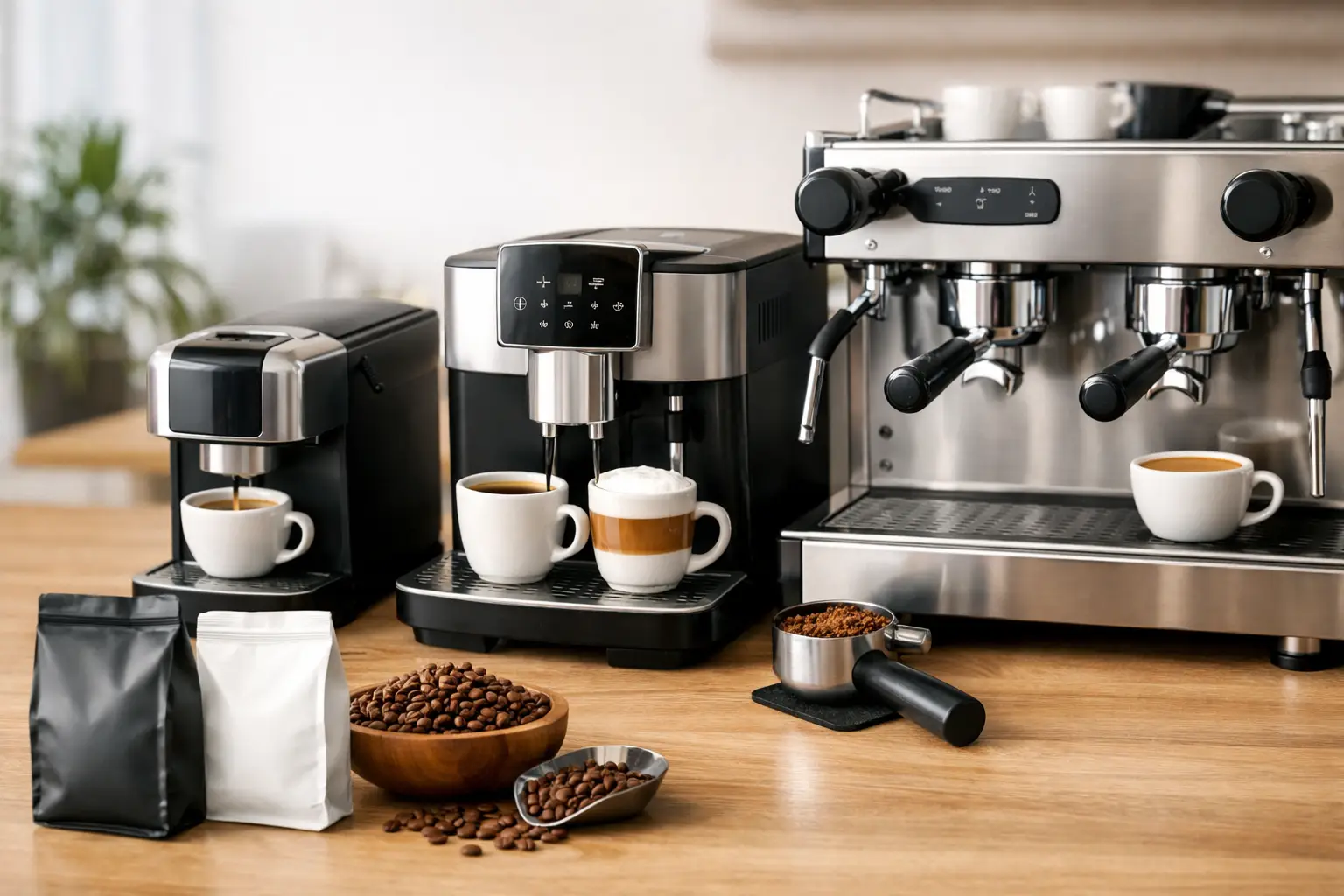
The biggest coffee machine mistake is not buying too small or too large. It is buying the wrong capacity for the way you actually serve drinks.
If you are figuring out how to select coffee machine capacity, start with one simple question: how many cups do you need to produce during your busiest period, not across the whole day. A machine that looks adequate on paper can still slow service, burn out staff, and compromise cup quality if it cannot keep up when the line starts forming.
For home users, capacity affects convenience, recovery time, and whether the machine feels enjoyable or frustrating. For cafés and foodservice operators, it affects ticket times, milk workflow, labor pressure, and equipment life. That is why capacity should be matched to real demand, not just budget or counter space.
What coffee machine capacity really means
Many buyers hear capacity and think only about the number of cups. In practice, capacity is a combination of brew output, boiler performance, steam power, recovery speed, and how long the machine can maintain stable performance under continuous use.
For espresso machines, capacity often comes down to how many shots and milk drinks you can produce consistently during a rush. A single-group machine may technically make excellent espresso, but that does not mean it can support a breakfast crowd ordering lattes back to back. Likewise, a high-capacity machine in a low-volume setting may spend most of its life underused while taking up space and increasing power consumption.
This is why machine size alone does not tell the full story. You need to think in terms of workload.
How to select coffee machine capacity for your setup
The right starting point is your peak demand. Daily volume matters, but peak demand matters more.
A small office that serves 40 cups across eight hours has very different needs from a kiosk that serves 40 cups in one hour. On paper, the totals match. Operationally, they are worlds apart. One setup needs moderate output with flexibility. The other needs speed, thermal stability, and room for staff to work without bottlenecks.
As a practical rule, estimate your busiest 30 to 60 minutes, then count the drinks likely to be ordered in that window. Separate black coffee from milk-based drinks, because steaming demand changes the equation. If most orders are cappuccinos and lattes, boiler and steam capacity matter just as much as espresso output.
For home users, the same logic applies at a smaller scale. If you usually make one or two drinks each morning, a compact machine may be perfect. If your household makes six milk drinks before work, that same machine may feel painfully slow.
Start with your busiest hour
Think beyond average sales. Average numbers hide pressure points.
Ask yourself how many drinks you need to serve in your busiest hour, how many of those drinks are espresso-based, and how many require milk steaming. If your team regularly prepares two drinks at once, you also need enough group heads and enough steam performance to support that rhythm.
For example, a low-volume coffee corner in a retail shop might be fine with a single-group commercial machine if demand is light and the menu is short. A brunch café with a strong latte trade will usually need at least a two-group machine, not because daily volume is huge, but because service speed matters when everyone orders at the same time.
Match the machine to the menu
Drink mix changes capacity needs fast.
If you mostly serve espresso, americanos, or long blacks, your machine can often handle more orders per hour than a similar setup focused on flat whites and mochas. Milk drinks take longer, use more steam power, and create more overlap between tasks. Add flavored drinks, iced variations, or multiple milk options, and output slows again.
Menus with a high percentage of milk beverages need stronger steam recovery and better multitasking. In those environments, buying the minimum acceptable capacity often becomes expensive later through slower service and inconsistent results.
Think about recovery time, not just brewing
A machine may perform well for the first few drinks and then struggle to maintain temperature or steam pressure. That is a capacity issue.
Recovery time is especially important for busy cafés, restaurants during breakfast service, and event setups. If the machine cannot bounce back quickly between orders, every drink after the first wave becomes slower. Staff compensate by rushing, quality slips, and the customer experience follows.
This is one reason experienced buyers often size slightly above current demand if growth is likely. Not dramatically bigger, just enough headroom to avoid outgrowing the machine too soon.
Capacity by use case
There is no perfect universal chart, but there are reliable patterns.
Home and small office use
If you are making a handful of drinks per day, compact machines make sense. The focus here is usually convenience, footprint, and dependable quality rather than nonstop output. A larger machine is not automatically better if it adds cost, takes longer to heat up, and occupies valuable kitchen space.
That said, if you entertain often or your household drinks mostly milk-based coffee, stepping up in boiler and steam performance can make daily use much smoother.
Small café, kiosk, and low-volume commercial use
This is where many buyers underestimate capacity.
A machine may appear oversized for weekday traffic, then struggle badly on weekends or during promotions. If your business has concentrated rush periods, a commercial machine with enough steam and shot capacity is a safer investment than a prosumer machine pushed beyond its comfort zone.
For kiosks and compact stores, space is always a factor, but service flow still comes first. A machine that fits the counter but slows the queue is not actually the better fit.
Busy cafés and multi-staff service
Once multiple baristas are working the machine during rushes, capacity must support simultaneous tasks. That usually means more group heads, stronger steam performance, and stable operation over extended periods.
At this level, the machine is part of a larger workflow that includes grinder speed, milk handling, cup staging, and water access. Choosing capacity in isolation is risky. The machine may be fast enough, but the station as a whole may still be too slow.
Common sizing mistakes
The most common mistake is buying based on average daily cups. The second is assuming a lower-priced machine is better value even if it cannot handle your menu or rush periods.
Another frequent issue is ignoring growth. If you are launching a café, new customer volume can be hard to predict. Some owners buy conservatively to control opening costs, which is understandable. But if the concept is built around coffee, underbuying can create an upgrade problem far earlier than expected.
There is also the opposite mistake: oversizing without a real need. Bigger machines cost more, use more power, and may require more bench space, water planning, and operator training. If your demand is genuinely modest, extra capacity may never pay you back.
What to check before you buy
When evaluating how to select coffee machine capacity, look at the machine specification sheet, but do not stop there. Ask how it performs during continuous service, how quickly it recovers between milk drinks, and whether it suits your actual menu.
You should also consider who will use it. A home enthusiast may accept a slower workflow for better control or a smaller footprint. A café team needs consistency under pressure. Staff skill level matters too. Some machines reward experienced baristas but may be less forgiving in fast-paced environments.
Utilities matter as well. Larger commercial machines may need specific electrical and plumbing support. Capacity is only useful if your site can support it properly.
If you are buying for a business, it helps to speak with a supplier that understands coffee equipment in the context of service volume, drink mix, and budget, not just product features. That kind of guidance often prevents costly mismatches.
A simple way to make the final decision
If you are stuck between two machine sizes, choose based on your busiest realistic scenario.
Picture your peak hour. Count the drinks. Consider how many are milk-based. Think about whether one person or two people will be working. Then ask which machine can deliver that service level comfortably, not just technically.
Comfortably is the key word. A machine running at its limit every day is rarely the right machine. The best fit gives you consistent quality, manageable workflow, and enough room for small spikes in demand.
Coffee equipment should make service easier, not force your team or your morning routine to work around its limits. Get the capacity right, and everything downstream feels more controlled – from extraction and milk texture to speed, staffing, and customer satisfaction.
A good machine does not just make coffee. It supports the pace you want to run at.