

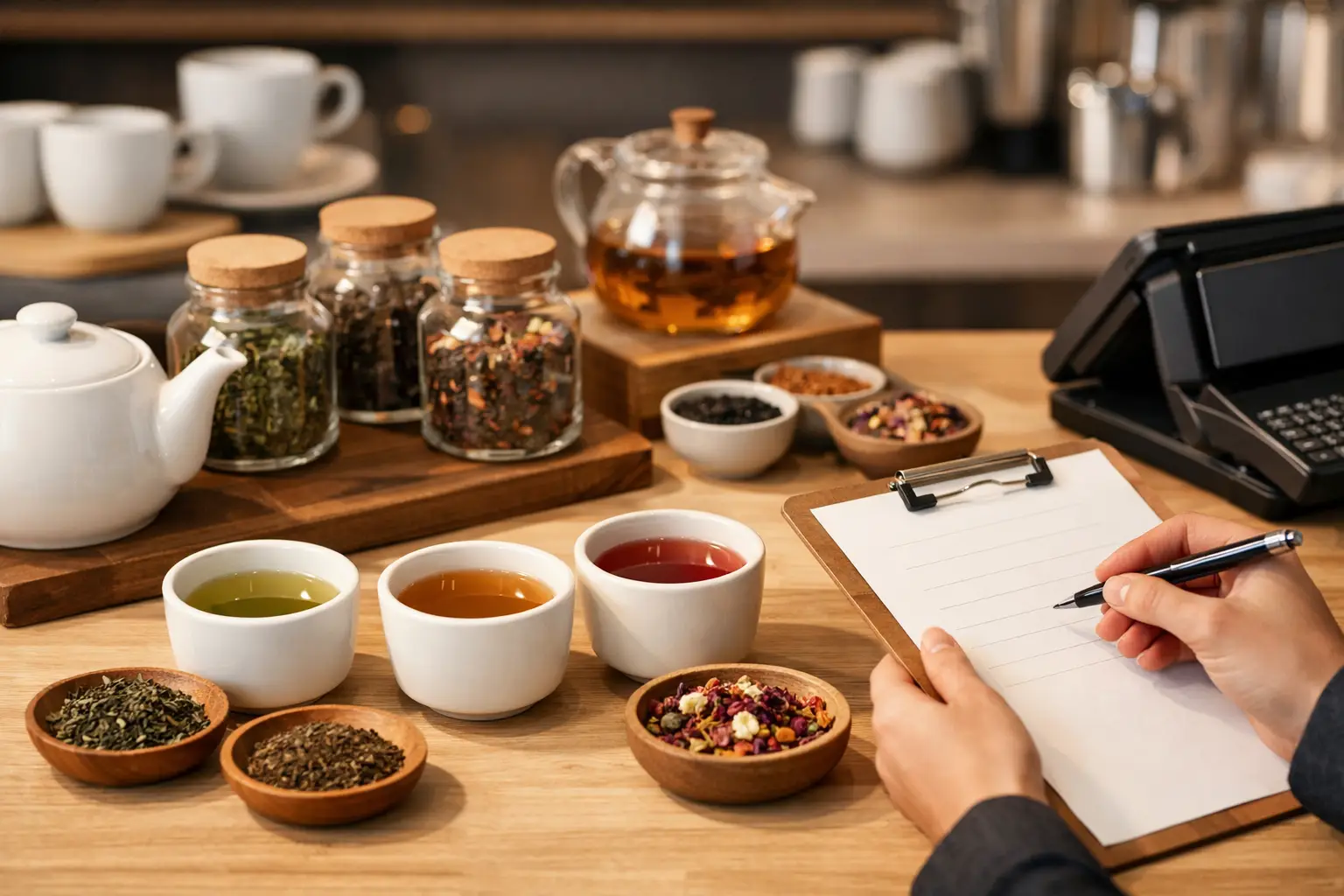
A lot of tea menus fail in the same quiet way. They try to look complete, so they add too many options, too many flavors, and too little structure. The result is a menu that feels busy to customers and expensive to run. If you are figuring out how to build a tea menu, the goal is not to stock every tea style. It is to create a lineup that is easy to understand, profitable to serve, and strong enough to earn repeat orders.
For cafés, restaurants, and beverage businesses, tea should work as hard as coffee does. It should cover different customer preferences, create add-on opportunities, and fit your service flow. For home sellers, boutique grocers, or smaller beverage counters, the same rule applies – every tea on the menu should justify its space.
Start with the job your tea menu needs to do
Before choosing products, decide what role tea plays in your business. In some cafés, tea is a secondary category that needs a compact, dependable offer. In others, it is a growth category that brings in customers who do not drink coffee, want lower caffeine options, or are looking for something lighter in the afternoon.
That difference changes everything. If tea is a supporting category, a short menu with excellent execution is usually the better move. If tea is a bigger sales opportunity, you can build more range, but only if your staff, storage, and equipment can support it without slowing service.
The strongest tea menus usually serve four groups well: customers who want something classic, customers who want something fragrant or flavored, customers who want wellness or caffeine-free options, and customers who want café-style tea beverages such as matcha, hojicha, or chai. Once you know which of those groups matter most to your audience, product selection becomes much clearer.
How to build a tea menu around customer demand
A practical tea menu starts with customer behavior, not tea theory. Most guests are not choosing between ten nuanced harvests. They are choosing between familiar, refreshing, comforting, or trendy.
That is why a balanced menu usually begins with the core anchors: one black tea, one green tea, one herbal tea, and one signature milk-based or powdered tea beverage. These categories do most of the commercial work. A black tea covers breakfast and milk tea drinkers. A green tea appeals to lighter tastes. An herbal option gives you a caffeine-free choice. A matcha, hojicha, or chai latte creates a higher-ticket drink with strong café appeal.
From there, build selectively. Earl Grey, jasmine, peppermint, chamomile, and English breakfast remain strong because customers recognize them and order with confidence. More niche options can be excellent, but they should earn their place through a clear identity. If a tea needs a long explanation every time, it may be better as a seasonal feature than a permanent menu item.
There is also a format decision to make early. Loose-leaf tea can elevate quality perception and aroma, but it asks more from your team in prep and consistency. Teabags offer speed, simplicity, and lower training risk. For many operators, a mixed approach works best: loose-leaf for a few premium highlights and high-quality sachets or teabags for the rest of the core menu.
Keep the menu tight enough to manage well
Tea looks easy on paper, but operationally it can get messy fast. Different brew times, different water temperatures, different cups, add-ons, powders, strainers, and milk choices all add friction if the menu is not designed carefully.
A good starting range for most cafés is six to ten tea items total, including both straight teas and prepared tea-based drinks. That is enough to look considered without overwhelming customers or tying up inventory. A smaller restaurant or kiosk may do better with four to six strong options. A tea-forward concept can go wider, but it should still be organized in a way that helps guests choose quickly.
The trade-off is simple. More variety can attract broader interest, but it usually means slower training, more dead stock, and more inconsistency. Fewer items can improve quality and speed, but if the range is too narrow, customers may overlook the category entirely. The best middle ground is a menu with clear coverage rather than maximum count.
Organize the menu by how people actually order
One of the easiest wins when learning how to build a tea menu is better menu organization. Customers rarely think in technical tea language. They think in moods, temperature, caffeine level, sweetness, and milk preference.
Instead of presenting tea as one long list, group it in a way that reduces decision fatigue. For example, structure can follow hot tea, iced tea, and tea lattes. Or you can group by black, green, herbal, and café-style specialty drinks. Either approach works as long as it is easy to scan.
Naming matters too. Keep names familiar where possible, then add a short description that helps the customer imagine the drink. “Jasmine Green Tea – floral, light, and refreshing” works better than a vague house name. If you offer matcha or hojicha, note whether it is served straight or as a latte and whether sweetness is standard.
This is especially important for mixed audiences. A regular tea drinker may want origin detail or leaf style, while a casual café guest simply wants something that tastes clean and easy to drink. Your menu should serve both without becoming crowded.
Price for margin, not just for comparison
Tea is often underpriced because it looks inexpensive to make. But the real cost is not just the tea itself. You have cups, lids, milk, sweeteners, toppings, labor, prep waste, and the cost of carrying slower sellers.
Straight brewed tea can support healthy margins, but only if quality and portioning are consistent. Tea lattes and specialty powder-based drinks often carry stronger average tickets, especially when customers add alternative milk or choose iced formats. That makes them valuable menu builders, not just trend items.
Be careful with low pricing as a strategy. If tea is priced too close to bottled drinks or too far below coffee, it can signal lower value. On the other hand, premium pricing only works if the menu and service justify it. Better ingredients, clear descriptions, proper teaware, and consistent flavor all support a stronger price point.
If you sell in Malaysia or Singapore, where café guests are increasingly familiar with matcha, hojicha, and chai formats, there is room to build a tea menu that spans both traditional brewed tea and more modern café beverages. The key is to keep pricing aligned with complexity and perceived value.
Build for service consistency
The menu is only as good as the drink customers receive. Tea suffers when brew standards are vague. If one barista steeps green tea for two minutes and another leaves it for five, the customer gets two different products.
Every item on the menu should have a simple brew spec: portion, water temperature, steep time, cup size, and whether milk or sweetener is included by default. This matters even more for iced tea and tea lattes, where dilution and sweetness can shift the whole drink.
Powder-based drinks such as matcha, hojicha, and chai also need standard recipes. If you want the menu to scale cleanly, especially in a busy café, choose products that are reliable and easy for staff to execute. This is where supplier quality matters. A dependable product range with clear use cases can save a lot of guesswork in menu development.
Add one or two signature drinks, not five
Signature drinks help tea feel like a category worth noticing. They also give you differentiation that plain brewed tea cannot always provide. But too many signatures can clutter the menu and complicate prep.
For most businesses, one or two tea-led house drinks are enough. That could be an iced yuzu green tea, a hojicha latte, a dirty chai, or a lightly sweetened matcha with a distinctive milk pairing. What matters is that the drink fits your brand and uses ingredients you can source consistently.
A good signature also pulls its weight commercially. It should photograph well, order well, and deliver enough margin to justify its place. If it is popular but labor-heavy, you may need to simplify the build. If it is beautiful but rarely ordered, it may be better as a limited feature.
Review the menu like an operator, not just a tea fan
The final test is practical. Look at each tea and ask four questions: Does it sell, does it fit the brand, is it easy to execute, and does it earn enough margin? If the answer is no to two of those, it probably does not belong.
This is where many menus improve. Not by adding more teas, but by editing harder. Remove overlap. Replace weak sellers with clearer options. If two green teas are splitting the same audience, keep the one with the better flavor consistency or stronger customer recognition.
If you are building a tea menu from scratch, start small and track what customers actually reorder. A menu that sells through consistently is stronger than a larger menu with hidden waste. Auresso’s approach to beverage sourcing reflects that same principle – practical range, dependable quality, and products chosen for real service environments, not just shelf appeal.
The best tea menu is not the one with the most choices. It is the one that makes ordering easy, service consistent, and every cup worth coming back for.