

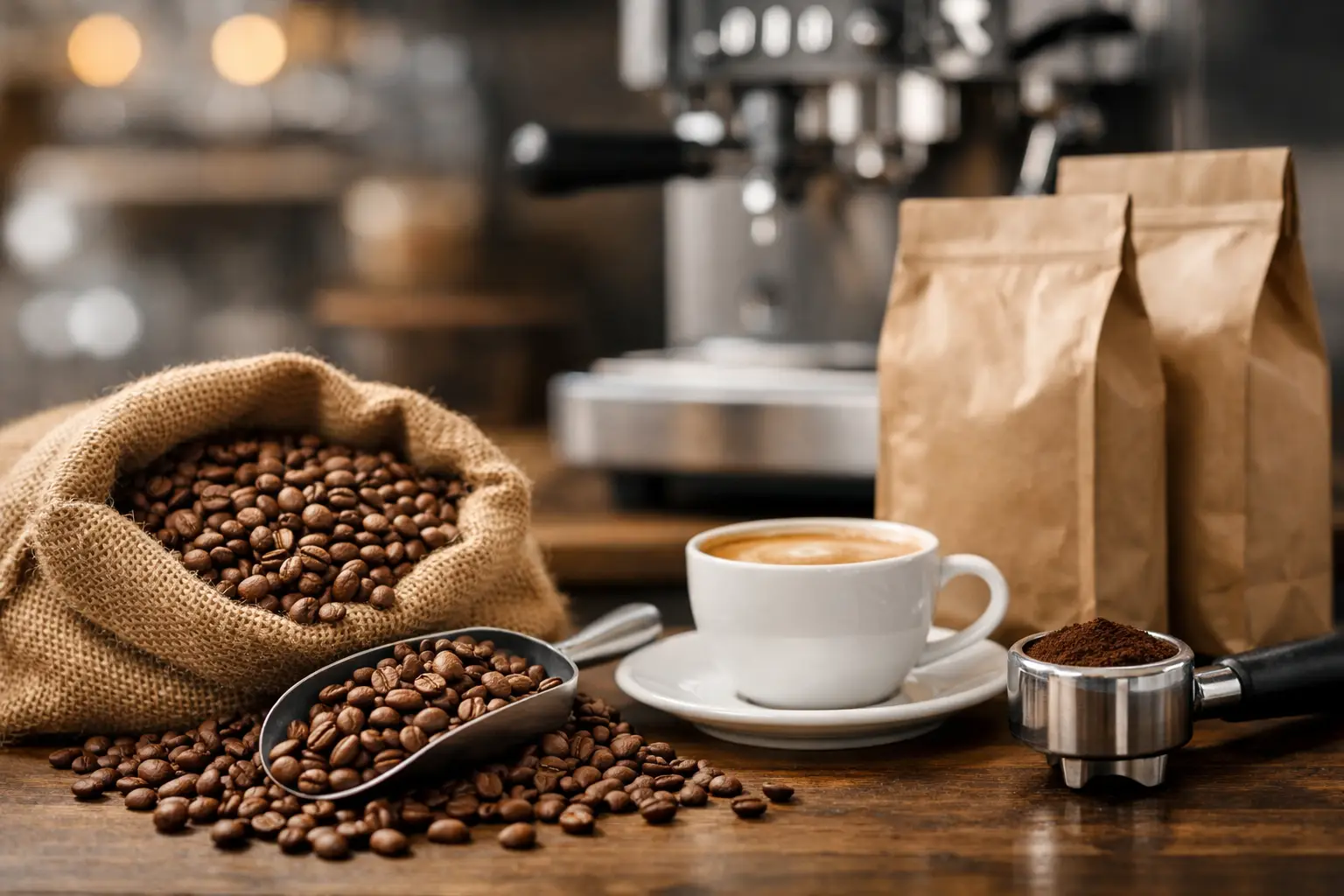
The wrong coffee bean rarely fails all at once. More often, it slips. Espresso starts running a little fast. Milk drinks lose their sweetness. A blend that tasted great in the sample bag turns flat once the café gets busy. That is why buying wholesale coffee beans for cafes is not just about getting a better price per kilo. It is about protecting consistency, margins, and customer trust in every cup.
For café owners and beverage teams, the best wholesale coffee program is the one that performs under real service conditions. It has to taste good, of course, but it also has to dial in predictably, work across changing shifts, and fit the menu you actually sell. A beautiful single origin may impress on cupping day, yet a dependable house blend might do more for daily sales if most of your orders are flat whites, lattes, and iced coffee. Good sourcing starts with that level of honesty.
What to look for in wholesale coffee beans for cafes
The first question is not whether a coffee is premium. It is whether it is right for your business. Cafés often buy based on flavor notes alone, then realize later that the roast is too light for their grinder setup, too seasonal for stable repeat orders, or too costly for their cup pricing. Wholesale buying works best when taste, workflow, and cost are considered together.
Consistency matters more than novelty for most stores. Customers may not describe extraction yield or solubility, but they notice when their usual drink tastes different. If your café builds loyalty on familiar flavor, your coffee needs to hold a stable profile over time. That usually means working with a supplier that curates dependable roasters, manages fresh stock carefully, and can advise on alternatives if one line becomes unavailable.
Cost also needs a wider lens. A cheaper bean is not always the better buy if it creates waste, requires constant recipe changes, or underperforms in milk. On the other hand, an expensive coffee is not automatically a smart choice just because it carries specialty credentials. The right bean earns its place by delivering a result your customers will order again.
Your menu should shape the bean, not the other way around
A café serving mostly milk-based drinks needs different coffee characteristics than a bar focused on black coffee or filter service. For espresso-heavy menus, body, sweetness, and chocolate or nut-driven notes often perform well because they stay present through milk. Fruity and floral coffees can be excellent, but they tend to be more polarizing and may require tighter dialing in.
If iced drinks are a major part of your sales, especially in warm climates, the coffee has to keep its structure after dilution. Some beans taste lively hot and thin when served over ice. Others hold up better and create a more reliable signature drink program. This is where sampling should go beyond straight espresso tasting. Test the coffee in the drinks you actually sell.
How to evaluate a wholesale coffee supplier
Beans matter, but support matters too. A strong supplier helps you reduce friction across ordering, training, and product planning. That means clear stock availability, practical recommendations, fast shipment, and a realistic understanding of café operations.
A supplier should be able to tell you how a coffee behaves, not just how it tastes. Is it forgiving in espresso? Does it work for automatic machines as well as traditional setups? Will it suit a medium-volume café with different baristas across the week? These are the details that affect service quality.
It also helps when your supplier can support the rest of the beverage program. Cafés rarely run on coffee alone. Tea, matcha, chai, chocolate, syrups, and equipment all affect purchasing efficiency and margin control. Working with one dependable source can simplify reordering and reduce the time spent chasing multiple vendors. That convenience has operational value, especially for lean teams.
Ask these practical questions before committing
Before placing a larger order, ask how often the coffee is roasted, what lead times look like, and whether the supplier can recommend options by drink style and target budget. Ask what happens if your chosen coffee goes out of stock. Ask whether they carry grinders, brewers, or café ingredients if you plan to consolidate purchasing.
None of these questions are overly technical. They are basic business checks. A supplier that answers them clearly is usually easier to work with long term.
Balancing price, quality, and margin
Every café wants quality assured and competitive pricing. The challenge is that quality and value are not fixed categories. They depend on your concept, customer expectations, and average spend per ticket.
If your café sits in a neighborhood where customers order daily, consistency and affordability may matter more than rotating rare lots. If your store positions itself as a specialty destination, customers may welcome seasonal coffees and pay more for them. Most cafés sit somewhere in between. They need a house coffee that is broadly appealing and profitable, then perhaps one or two featured options for interest and upselling.
This is why cup cost should be calculated alongside selling price and waste. If a bean costs more but improves extraction stability and reduces remakes, it may support margin better than a cheaper alternative. If a coffee tastes impressive but moves slowly, the hidden cost may be stale stock. The best buying decision is often the coffee that performs well enough to keep customers happy while leaving room for healthy menu pricing.
Roast profile and origin: where preference meets practicality
Roast profile should match both your menu and your equipment. Medium to medium-dark roasts are often easier to work with for milk drinks and high-volume service. Lighter roasts can produce excellent clarity, but they may be less forgiving and require more attention to grind, dose, and extraction.
Origin plays a role too, but it should not be treated like a shortcut. Brazilian coffees may bring chocolate and nutty comfort. Ethiopian lots may bring florals and fruit. Colombian coffees often offer balance and sweetness. Those are useful patterns, not guarantees. Processing method, roast development, and blend design matter just as much.
For many cafés, blends are the practical answer. A well-built blend can create a stable house profile, control cost, and smooth out seasonal variation. Single origins work well when the customer base is curious and the staff can communicate what makes them special. It depends on your concept and whether the coffee supports the rest of your service, not distracts from it.
Why reliability is part of coffee quality
A great bean that arrives late or inconsistently is not a great wholesale product. Cafés need supply they can count on. That includes stock continuity, responsive communication, and a straightforward ordering process.
For operators in Malaysia and Singapore, this becomes especially relevant when sourcing imported roasters. Access to strong international selections is valuable, but shipping costs and delivery uncertainty can quickly eat into the benefit. This is where a curated supplier such as Auresso can make sense. It gives cafés access to specialty coffee, beverage ingredients, and equipment in one place, with buying convenience that suits real trading conditions rather than ideal ones.
Reliability also shows up in smaller ways. Freshness windows should make sense. Product pages should be clear. Reviews and ratings should help buyers decide faster. A good wholesale partner respects that café owners are making commercial decisions, not hobby purchases.
Building a coffee program that can grow with your café
The smartest wholesale coffee decision is rarely the most exciting one on day one. It is the one that still works when volume increases, when a new barista joins, or when the menu expands into matcha, chocolate, or batch brew.
Think in terms of a coffee program rather than a single bean. Your house espresso should be easy to repeat. Your featured coffee should add interest without creating chaos. Your supplier should make it easier to scale, not harder. That may mean starting with one dependable blend and adding more complexity later, once the fundamentals are solid.
It also helps to review performance regularly. If a coffee is getting praise from staff but not translating into sales, something is off. If customers keep reordering the same latte and your team can dial in quickly every morning, that is a strong sign the bean fits the business.
Good cafés are built on repeatable decisions. Wholesale coffee buying is one of them. Choose beans that make service smoother, drinks better, and margins healthier, and your coffee will do more than fill the hopper – it will help the whole café run better.
The best wholesale choice is the one your team can work with confidently on a busy Monday, not just admire during a quiet tasting.